
Common Tarot Mistakes Beginners Make (and How to Avoid Them)
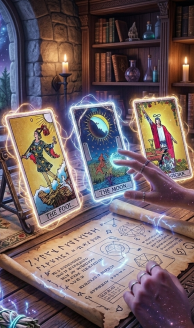
The whole concept of using the tarot is no longer kept in the isolated niche of esoteric literature and is now used in mainstream discourse on the subject of self-development. However, excitement and interest in tarot cards do not suffice. Without the right interpretation of the meaning and usage of tarot cards, newbies get confused and may abuse the practice.
Often, there may also be a question in one’s mind: What are some common Tarot mistakes made by beginners? The response is not mystical, but practical instead. Most common mistakes involve false expectations, rigidity, or misunderstanding of tarot usage itself. How to read tarot cards for beginners is not about learning the meanings of the Tarot; it is about developing interpretative abilities, discernment, and awareness.
Let’s take a closer look at where new readers often go wrong and, more importantly, how to get it right.
Common Beginner Mistakes in Tarot Reading
Tarot is a language of symbols. Like any language, it demands patience and practice. Many so-called "mystical failures" are merely beginner tarot reading mistakes that could be corrected right at the outset.
So, what are some common Tarot mistakes made by beginners?
- Trying to treat the cards as fixed predictions instead of dynamic guidance.
- Depending solely on keywords from books, without thinking about context.
- Disregarding card positions within spreads.
- Overthinking reversals or not performing them at all.
- Emotionally leading questions or not clearly worded.
One major issue is over-reliance on tarot guidebooks. While tarot books for beginners are very helpful learning tools, they are not meant to replace interpretation. A guidebook may list "Tower = disaster," but in context, it could mean liberation, the truth, or restructuring that is needed. Cards speak through relationships, not isolated definitions.
Another repeated mistake is neglect of the spread structure. A "past" position is not equivalent to an "advice" position. When amateur readers forget about placement, the readings become vague and inconsistent.
Understanding that tarot reflects perspective, not fate, is very important. Operating without this insight can get very frustrating, very fast.
What this looks like in a real reading
- Treating cards as fate: Pulling the 10 of Swords for “Outcome” and declaring, “It’s doomed.” In context, if the “Advice” is 6 of Swords, the message may be: “Don’t drag this out - transition cleanly and you’ll recover faster.”
- Keyword tunnel vision: Reading 7 of Cups only as “illusions” when it lands in “Strengths.” Here it can point to imagination and creative options - use a shortlist, not the whole buffet.
- Ignoring positions: 3 of Swords in “What to do” isn’t “you will be heartbroken.” It can be a nudge to have the hard conversation, name the hurt, and let truth heal.
Spread anatomy 101 (quick primer)
- Past/Root: What shaped the present - do not offer advice from this slot.
- Present/Current energy: Name dynamics, not verdicts.
- Challenge: The friction point; avoid catastrophizing here.
- Advice: Actionable behavior, not prediction. Phrase as “Lean into X; reduce Y.”
- Outcome/Trajectory: A conditional forecast. Anchor with “if/then” language.
Practice: Before interpreting, label each position out loud and restate the question. This prevents drifting into generic statements.
Guidebooks are maps, not the territory
Keep a lean set of personal anchors for each card (3–5 lived meanings). Example, The Tower (Rider–Waite–Smith):
- Shock that frees: sudden truth ejects you from a stuck structure.
- Unsustainable foundations: a system fails so it can be rebuilt right.
- Ego check: humility after overconfidence.
Then layer in spread position and neighboring cards. Tower next to 4 of Pentacles (Advice): “Loosen the grip before life does it for you.” Tower next to The Star (Outcome): “After the shake-up, healing and clarity follow.”
Reversals without fear
Beginners often overcomplicate reversals. Pick one method and apply it consistently:
- Blocked/Delayed: reversed = same energy, but stuck or postponed (reversed Chariot: momentum exists, alignment doesn’t).
- Internalized/Subtle: reversed = turned inward or quiet (reversed Hermit: isolation vs. wise solitude).
- Reduced voltage: reversed = dialed down (reversed Strength: courage is present but wavering).
Pro tip: If reversals feel overwhelming, read upright-only for 30 days and use context, elements, and numerology for nuance. Add reversals later.
Missteps in Asking and Interpreting Tarot Questions
Quite commonly, new people believe that mixed readings result from bad cards. The exact opposite is true.
Here is where asking the wrong tarot questions is a problem. Indeterminate questions, such as “What will happen to me?” result only in indeterminate answers. The best tarot questions are clear and open-ended, like “What do I need to understand about this situation?”
What not to do with tarot cards for beginners? Here are a few examples:
- Ask the same question repeatedly, expecting a different answer.
- Frame questions with the purpose of controlling the outcomes.
- Demand exact timelines without context.
- Read when feeling emotionally overwhelmed.
- Spread positions are ignored, as are card relationships.
A second mistake that many people make is ignoring tarot reversals. Newbies often overlook reversals since they often seem complex. Some, also, due to a lack of knowledge, may think reversals must always be negative. This is, however, not true.
Have you ever been curious about what not to do with tarot cards for beginners?
Simplest answer: avoid using the tarot cards as if they were a slot machine for certainty.
Clarity in questioning translates to clarity in interpretation
Better questions cheat-sheet (with reframes)
- Instead of: “Will I get the job?” Try: “What strengthens my candidacy and what undermines it?”
- Instead of: “Is my ex coming back?” Try: “What is healthiest for my love life in the next three months?”
- Instead of: “When will I meet someone?” Try: “What conditions help me meet compatible partners sooner?”
- Instead of: “Should I move?” Try: “What are the likely outcomes if I stay vs. if I move?” (two piles or a forked spread)
Clarifiers used wisely: Pull clarifiers only if a specific card/position is unclear and state the intent: “Clarify the ‘Challenge’ position.” Stop after 1–2.
Reading when emotional
- Pause 10 minutes. Breathe in for 4, out for 6, seven times.
- Write a one-sentence, neutral question.
- Set a timer for 15 minutes; end the reading when it rings.
- If you pull The Devil, 9 of Swords, or 3 of Swords, add a second spread titled “Support” before making decisions.
Simple study habits that accelerate skill
- Daily draw (2-card): “Theme” + “How to work with it.” At night, jot one real-life example that matched.
- Post-reading reflection: After 24–72 hours, add a note: What landed? What missed? Adjust your personal meanings.
- Calibration readings: Practice on known past events. Ask, “What dynamics led to X?” You can verify accuracy.
Avoid cross-system confusion: Tarot (especially Rider–Waite–Smith) and Lenormand are different systems. Don’t mix Lenormand’s literal, combinatory method with tarot’s contextual symbolism in the same spread; learn each on its own terms.
Trusting Your Intuition and Unspoken Rules
There is another, lesser-known layer of tarot readership, rarely mentioned in books for novices, and it has to do with discernment, ethics, and timing.
On one hand, many new readers have asked “What is the unspoken rule of tarot?”, and the answer is simple: tarot augments, but does not supplant, personal will.
Ethics reading comprises:
- Refraining from asking invasive queries about others without permission.
- Not reading obsessively about the same topic.
- Respecting emotional preparedness before asking questions.
Balancing studying with trusting tarot intuition is essential to developing skill. There is no guesswork involved in intuition; it is recognition of patterns based on experience.
Newcomers may not trust their feelings because they contradict the definition given in the book. However, interpreting is not passive. The book may teach people the means of expression through vocabulary; intuition is the key to fluency.
Yet another ignored factor is timing. It must be recognized that tarot card readings only show the current energy direction and not destiny.
Building intuition responsibly
- First glance, then reference: Say what you notice in the image (colors, gaze, motion), then consult notes if needed.
- Body check: Notice reactions (tight chest with 9 of Swords? curiosity with Page of Wands?). Track patterns in your journal.
- Symbol spotlight: Pick one symbol per card (e.g., the lion in Strength) and tie it to the question.
Ethics in practice (quick scenarios)
- Third-party snooping: Reframe “Is my coworker betraying me?” to “How can I protect my interests and foster transparency at work?”
- Consent script: “I’m happy to read for you. Are you comfortable with me exploring X, or should we focus on what’s best for you regardless of their actions?”
- Obsessive loops: If you’ve read on the same topic 3 times this week, impose a two-week pause or require a new action taken before revisiting.
About timing
- Use windows, not exact dates: “Next 4–8 weeks” gives clearer, testable guidance without false precision.
- Ask for conditions: “What accelerates or delays this?” Note the levers you can pull.
Can Tarot Readings Be Wrong?
This gives rise to the essential question: Can a tarot reading be wrong?
The short answer is, yes - if misunderstood. But not in the way people think.
Tarot does not function as a prediction tool. It merely mirrors reality, state of mind, and progress of the moment. If you ask yourself, “Can a tarot reading be wrong?”, you expect a yes or no kind of answer. Tarot, however, does not function this way.
Mistakes tend to occur when readers:
- Force the cards to affirm what they already believe.
- Project fear or desire on neutral symbolism.
- Ignore personal intuitions and rely instead upon memorized meanings.
- Misread context within spreads.
The cards don't dictate the outcome. It is our decision. The reading changes with the decisions.
Avoid dogmatic thinking, balance theory with intuition, and seek tarot as a contemplative aid rather than a fortune-telling machine. Personal growth using tarot follows the pattern of individual growth: steady, hard work, and immensely gratifying.
But with patience and explanation, the cards become less mysterious - and more meaningful.
Quality-control checklist (use after each reading)
- Did I restate the question and spread positions?
- Did I distinguish advice from outcome?
- Did I speak in “if/then” terms for trajectories?
- Did I check for bias (what I wanted to see)?
- Did I pull unnecessary clarifiers?
- What action is suggested within my control?
A simple 6-step reading flow
- 1. Center: One minute of breath. Name the question.
- 2. Lay the spread: Label each position out loud.
- 3. First impressions: Storyline in one sentence.
- 4. Position-by-position: Tie each card to its slot and the question.
- 5. Synthesize: “Given A+B, the most helpful action is C.”
- 6. Close and note: Write one practical step and a date to review.
FAQ
- Do I need to memorize all 78 meanings before reading? No. Start with a few core meanings per card and build through practice and journaling.
- How often can I read on the same topic? Set a cool-off period (1–2 weeks) or require a tangible action before revisiting.
- Are “scary” cards always bad? No. The Tower can free you; Death is transition; 9 of Swords highlights anxiety you can address.
- Should beginners use reversals? Optional. Upright-only is fine. Add reversals when you can apply one consistent method.
- Do I have to cleanse my deck? Not required, but a simple ritual (knocking, shuffling, a cut, a breath) can help you focus.
- Can I read for myself? Yes. Expect more bias - use the checklist, keep questions process-oriented, and time-limit the session.
