
Recognizing the Importance of Numbers in Tarot: A Manual for Tarot Number Interpretation
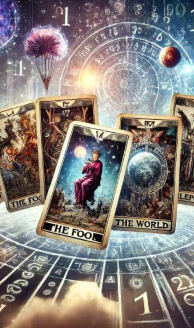
Tarot card readings rely heavily on numbers. The numbers on the cards add a second layer of meaning that deepens the message beyond imagery alone. Because numerology and Tarot are closely intertwined, learning Tarot numbers helps you hear what each card is really saying.
Numerology reveals patterns of growth, challenge, and cycles. Whether you are doing a daily Tarot reading or a full spread, paying attention to numbers can uncover hidden links between cards and clarify the story. Over time, noticing the numbers helps you refine your personal reading logic so your interpretations become consistent and confident.
Tarot Number Meanings: An Overview
Numbers structure both the Minor and Major Arcana. In the Minors, the numbers 1 through 10 repeat across the four suits - Wands (fire), Cups (water), Swords (air), and Pentacles (earth). The shared number shows the stage of a process; the suit shows how that stage expresses itself (energy, emotion, thought, or material life).
In the Majors, numbers 0 through 21 mark life lessons and initiations from The Fool (0) to The World (21). Reading with numerology lets you connect a Minor’s number to its “parent” Major (for example, all 4s relate to The Emperor), adding context and depth.
Close Examination of Tarot Card Number Interpretation
Numbers 1 through 3
- One (Aces): Seeds, initiative, singular focus. Ace of Wands sparks action; Ace of Cups opens the heart; Ace of Swords brings a clarifying truth; Ace of Pentacles offers a concrete opportunity. Echoes I The Magician: will, channeling potential into form.
- Two: Polarity, choice, reflection. Two of Wands plans the next step; Two of Cups bonds; Two of Swords pauses to deliberate; Two of Pentacles juggles priorities. Mirrors II The High Priestess: inner balance, listening before moving.
- Three: Expansion, expression, collaboration. Three of Wands looks outward; Three of Cups celebrates support; Three of Pentacles builds with a team; Three of Swords shows the mind’s expression cutting to the heart (the “growth” lesson can be painful in Air). Resonates with III The Empress: creativity, fertility, results beginning to show.
Numbers 4 through 6
- Four: Structure, stability, foundations. Four of Wands anchors joy and belonging; Four of Swords prescribes rest; Four of Cups stabilizes emotion into apathy if unchecked; Four of Pentacles secures resources (or clutches them). Tied to IV The Emperor: order, boundaries, authority.
- Five: Disruption, testing, adjustment. Five of Wands is healthy competition or chaos; Five of Cups grieves and reframes; Five of Swords warns of hollow victories; Five of Pentacles reflects scarcity and seeking support. Relates to V The Hierophant: beliefs under pressure - what holds and what must evolve.
- Six: Harmony, alignment, relief. Six of Wands receives recognition; Six of Cups recalls innocence; Six of Swords transitions to calmer waters; Six of Pentacles balances giving and receiving. Echoes VI The Lovers: values-based choices and integration.
Numbers 7 through 10
- Seven: Evaluation, inner discipline, spiritual testing. Seven of Wands defends ground; Seven of Cups sorts vision from illusion; Seven of Swords strategizes; Seven of Pentacles assesses progress. Connects with VII The Chariot: control through focus, not force.
- Eight: Power, movement, skill in action. Eight of Wands accelerates; Eight of Swords shows mental constraints to be mastered; Eight of Cups seeks a higher truth; Eight of Pentacles refines craft. In the Rider–Waite–Smith tradition, aligns with VIII Strength: composed courage and mastery.
- Nine: Culmination, ripeness, consequence. Nine of Wands stands resilient; Nine of Swords confronts the mind’s edge; Nine of Cups enjoys contentment; Nine of Pentacles savors earned independence. Reflects IX The Hermit: wisdom distilled from experience.
- Ten: Completion and turning of the wheel. Ten of Wands shows burdens at peak; Ten of Swords a definitive mental ending; Ten of Cups communal fulfillment; Ten of Pentacles legacy and long-term security. Relates to X Wheel of Fortune: endings that become beginnings.
Major Arcana Numbers and Their Interpretations
Major Arcana numbers are milestones. 0 The Fool is the open field before the path - emptiness, faith, reset. From there, 1 through 10 trace personal development (Magician to Wheel), and 11 through 21 broaden into societal, karmic, and spiritual integration (Justice through The World).
- Justice and Strength numbering: In Rider–Waite–Smith decks, VIII is Strength and XI is Justice. In some traditions (e.g., Marseille), these are swapped. Read with your deck’s numbering and be consistent.
- Link Majors to Minors: When many Minors share the same number, consider the corresponding Major as your “theme card.” For example, multiple 4s point to The Emperor questions: What needs structure? Where are rules helpful - or stifling?
- Zero in practice: If The Fool appears with many Aces or Tens, the spread emphasizes resets. The number 0 amplifies liminal space: step lightly, travel light, and welcome the unknown.
Tarot Number Use in Readings
Use numbers as a cross-check that sharpens interpretation without overriding imagery or intuition. Practical ways to work numerology into your spreads:
- Scan for repeats: Note any number that appears two or more times. Repeating 3s? Collaboration and creative growth are central. Repeating 5s? Expect friction that reveals what needs to change.
- Watch sequences: Aces → Twos → Threes show a clear build (seed, choice, expression). Nines → Tens show culmination and handoff to a new cycle. Example: Ace of Cups, Two of Cups, Three of Cups in a relationship reading maps from spark to choice to shared joy.
- Cross-check with suits: The same number behaves differently by element. A “4” in Wands feels celebratory stability; a “4” in Cups warns of emotional stagnation. Let the suit tell you how the number acts.
- Consider timing or quantity (optional): The number can hint at “how many” or “how soon.” Many readers time by suit pace (Wands fast, Swords moderately fast, Cups medium, Pentacles slow). For example, a “3” in Wands may be days; a “3” in Pentacles may be weeks or months. Treat timing as tentative and confirm with follow-up cards.
- Calculate a Quint card (overall theme): Add the numbers of your spread and reduce to 1–21 to find a guiding Major. Method: Aces=1…Tens=10; Pages=11, Knights=12, Queens=13, Kings=14; Majors keep their printed numbers (Fool=0). Example: 3 of Pentacles (3) + Ten of Swords (10) + Queen of Cups (13) = 26 → 2+6=8 = Strength. Read Strength as the keynote: respond with courage and steadiness.
- Journal the numbers: Record dominant numbers and how they played out. Over a month you may notice, for instance, that “7” weeks are introspective and strategic for you, which then refines future readings.
- Use reversals to nuance the number: A reversed Four suggests rigidity or structures past their use-by date; a reversed Six can show disharmony or imbalanced giving.
Typical Mistakes in Tarot Number Interpretation
- Forcing positivity/negativity: Numbers describe stages, not moral verdicts. A Five is not “bad”; it is a pressure-test. Let context and suits determine tone.
- Overriding the picture: Numerology supports the art; it does not replace it. Always reconcile number, suit, and image.
- Ignoring deck conventions: Be consistent with your deck’s Strength/Justice numbering and any house system you use. Consistency builds accuracy.
- Assuming Ten is “the end” of everything: Tens close a chapter in that suit’s arena; life continues in a new form. Look for Aces nearby to see the handoff.
- Muddy court handling: If you include courts in quint math, state your values (Page=11, Knight=12, Queen=13, King=14) and stick with them. If courts feel awkward numerically, leave them out of calculations and read their roles instead.
A quick note on Lenormand numbers
Lenormand card numbers (1–36) identify the card order and house positions, not numerological stages as in Tarot. If you read both systems, keep their number logic separate to avoid cross-wiring meanings.
Concrete Examples
- Career spread shows: Three of Pentacles, Eight of Pentacles, Ten of Pentacles. Numbers map a work arc: 3 (collaboration) → 8 (mastery) → 10 (legacy). Advice: invest in skill-building with others now to secure long-term results.
- Relationship check-in: Two of Swords, Six of Cups, Five of Wands. The “2” pauses for clarity; “6” recalls warmth; “5” flags tension. Numerically, move from stalemate to shared tenderness, then renegotiate roles to handle emerging friction.
- Daily draw: Ace of Wands reversed. The “1” is present but blocked. Start small: one email, one pitch, one lap. Clear resistance and the Ace’s spark catches.
- Pattern of 7s in a Celtic Cross. Expect a week of assessment and strategic repositioning. Bring Chariot-like focus to avoid diffusion.
FAQ
- How do I read court cards numerologically? Option A: Assign Page=11, Knight=12, Queen=13, King=14 for calculations like the Quint. Option B: Exclude courts from math and read them as roles/people/approaches while letting numbered Minors carry the numeric arc. Choose one method and be consistent.
- Do I use 0 or 22 for The Fool in calculations? Most readers use 0. If your sum reduces to 22, you can read that as The Fool (0) or reduce again to 4 and consider Emperor themes alongside Foolish openness. Note both and see which fits the question.
- Can I combine Tarot numerology with birth/life-path numbers? You can, but keep it simple. If you bring in personal numerology, treat it as color, not a constraint. The spread’s numbers take priority.
